
Clear roles, usable SOPs, and training that actually works.
Accountability isn’t about policies, discipline, or after-action reviews. It’s about whether people clearly understand their role, the task they’re performing, the risks involved, and how the work is supposed to be done—before something goes wrong.
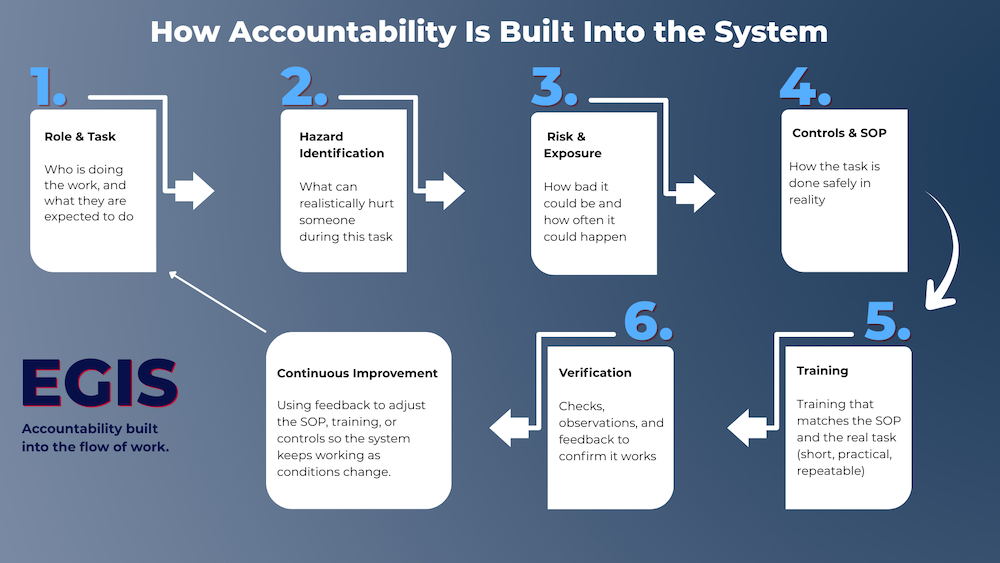
Most organizations rely on accountability after an incident: investigations, corrective actions, and retraining. This approach focuses on designing accountability into the system itself, so expectations, controls, and training are clear upfront and reinforced through normal operations.
When accountability is built into the flow of work, people don’t have to guess. The system guides decisions, reduces variability, and prevents problems instead of reacting to them.
Role-specific SOPs aligned to how work is actually performed
Clear task expectations tied to real job conditions, not assumptions
Hazard and risk identification embedded into task design
Simple, employee-level procedures written to be followed in the field
Documentation designed to hold up under audits, incidents, or review
Processes that support work instead of interrupting it
How hazards, controls, and procedures are connected instead of isolated
How training reinforces the SOP, not contradicts it
How supervisors are equipped to direct, observe, and correct in real time
How systems are reviewed, adjusted, and improved as operations change
How employees are expected to perform tasks consistently, not guess
Training that checks a box but doesn’t change behavior
Accountability that only appears after an incident
Confusion about who owns what during normal operations
Blame-driven responses that mask system failures
Processes that collapse under scrutiny because they were never operational
SOPs that exist on paper but fail in practice
When incidents happen, organizations aren’t judged by attendance rosters — they’re judged by what they trained, how they evaluated, and what they enforced.
This program is designed so trainer decisions, evaluations, and documentation are defensible, repeatable, and consistent.
2026 Copyright. All rights reserved.